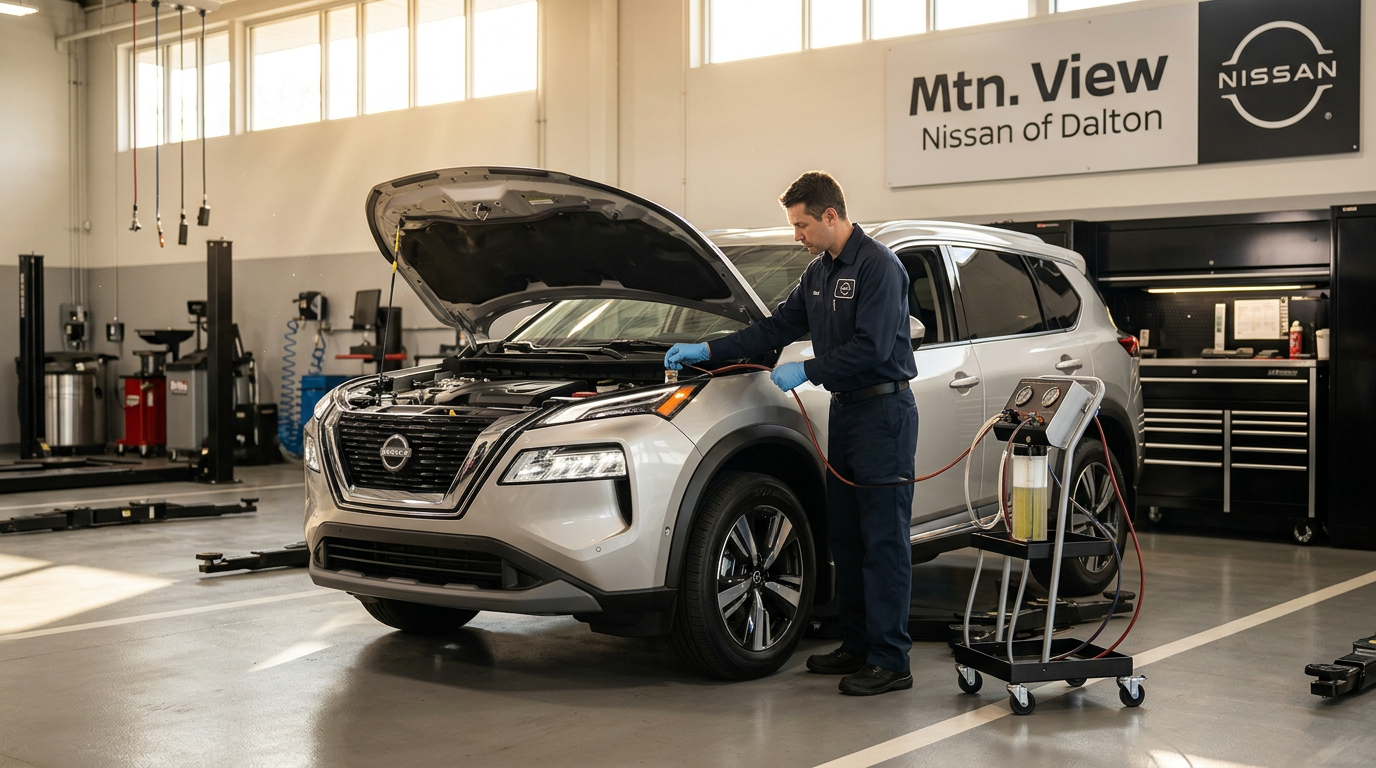
Essential automotive fluids in a Nissan require inspection at every routine oil maintenance visit, with replacement schedules dictated by the specific fluid type, vehicle model, and real-world driving severity. Engine oil requires replacement every 5,000 to 10,000 miles, while brake fluid should be replaced every 20,000 miles or two years. Transmission fluid in an Xtronic CVT demands electronic inspection every 30,000 miles, and factory-fill engine coolant holds a baseline service life of 105,000 miles or seven years before requiring its first drain and refill.
Every Nissan model uses dedicated hydraulic, cooling, and lubricating fluids engineered to balance internal operating pressures, control heat, and protect metal friction surfaces. Over time, heat cycles break down chemical additive packages, friction materials saturate fluid passages, and environmental moisture lowers thermal thresholds. Setting a structured maintenance schedule protects vital mechanical components from premature wear and maintains factory warranty protections.
Operating conditions heavily influence fluid breakdown. Nissan outlines severe operating standards that accelerate maintenance timetables, including frequent short-distance trips under five miles, stop-and-go driving in hot weather, prolonged engine idling, driving in dusty environments, and regular hill climbs across elevation shifts near the Appalachian foothills in Dalton. Under severe schedules, engine oil intervals shorten to 5,000 miles or six months, while differential gear oil, transfer case lubricants, and transmission fluids on select models require full replacement as early as 20,000 miles or 24 months.
Routine visual inspections between service appointments help catch slow leaks and fluid oxidation early. Drivers can check clear reservoir tanks under the hood for clean fluid levels, including engine coolant, brake hydraulic fluid, and windshield washer reservoir volume. Washer fluid must be matched to seasonal freezing thresholds rather than topped off with water or substitute coolants. For assistance verifying fluid specifications or checking fluid condition, motorists can reach our team by giving our service advisors a quick call or visiting our service center on East Walnut Avenue.
| Fluid System | Standard Inspection Interval | Replacement Interval (Normal Use) | Replacement Interval (Severe Use) |
|---|---|---|---|
| Engine Oil & Filter | Every 5,000 to 7,500 miles | 5,000 to 10,000 miles / 6–12 months | 5,000 miles / 6 months |
| Brake Fluid | Every 10,000 miles | 20,000 miles / 24 months | 10,000 miles / 12 months |
| CVT Fluid (NS-2 / NS-3) | Every 10,000 to 15,000 miles | Inspection / drain & fill at 30,000 to 60,000 miles | 20,000 miles / 24 months |
| Engine Coolant | Every 10,000 miles | 105,000 miles / 84 months (first service) | 75,000 miles / 60 months (subsequent) |
| Transfer Case & Differential | Every 15,000 miles | 30,000 miles / 36 months | 20,000 miles / 24 months |
Table of Contents
- How Often Should Nissan Brake Fluid Be Flushed?
- How Can You Tell if a Nissan CVT Is Failing Due to Old Fluid?
- How Technicians Inspect CVT Degradation and Perform Drain and Fill Service
- Where to Get Certified Nissan Fluid Top-Ups and Flushes in Dalton
- Nissan Fluid Maintenance FAQs: CVT, Brake Fluid, and Service Intervals
- Protecting Your Powertrain with Scheduled Fluid Care
How Often Should Nissan Brake Fluid Be Flushed?
Nissan brake fluid should be flushed and replaced every two years or 20,000 miles under normal driving patterns, and shortened to 10,000 miles or 12 months under severe operating schedules. Routine replacement prevents water accumulation from degrading stopping distance and shields precision hydraulic anti-lock brake actuators from internal corrosion.
Hydraulic brake fluid operates inside a sealed system, but atmospheric moisture gradually permeates microscopic pores in flexible rubber brake hoses, fluid reservoir seals, and bleeder valves. Nissan vehicles use glycol-based DOT 3 or DOT 4 hydraulic fluids, which are hygroscopic, meaning they naturally absorb ambient water vapor. As moisture concentration rises above 2 to 3 percent, the boiling point of the fluid drops drastically. Under continuous braking down steep grades, contaminated fluid can boil, generating compressible steam pockets that lead to a spongy pedal, extended stopping distances, or sudden brake fade.
Moisture contamination also oxidizes internal steel lines, caliper piston bores, and sensitive valving inside the electronic stability and anti-lock brake modulators. Microscopic rust particles suspended in degraded brake fluid score piston seals, creating internal hydraulic pressure loss. Technicians test brake fluid using digital optical refractometers and boiling point analyzers to measure exact moisture saturation levels during multi-point safety inspections.
Performing a certified brake fluid exchange involves purging every caliper circuit until fresh, clear fluid flows without trapped air pockets. Our certified technicians use manufacturer-approved pressure-bleeding equipment that cycles hydraulic fluid through the entire system without exposing sensitive master cylinder seals to unmetered dry strokes. Drivers performing personal maintenance can source factory-formulated fluids directly through our dedicated Nissan parts department to ensure full compatibility with internal seals.
How Can You Tell if a Nissan CVT Is Failing Due to Old Fluid?
A Nissan continuously variable transmission suffering from fluid breakdown displays clear mechanical symptoms, most notably delayed gear engagement, shuddering during acceleration, transmission whining noises, and sharp burning chemical odors. Recognizing these physical warnings early allows drivers to service the hydraulic system before permanent internal belt or pulley surface damage occurs.
Continuously variable transmissions rely on continuous friction between a steel push-belt and two variable-diameter steel pulleys, balanced against high hydraulic pressure. Specialized traction fluid provides hydrodynamic lubrication to internal bearings while creating sufficient microscopic shear friction between the steel belt elements and smooth pulley faces. As mileage accumulates, extreme thermal cycles shear the fluid's complex polymers, diminishing its friction-modifying properties and lowering its ability to dissipate operational heat.
When transmission fluid loses its viscosity and chemical shear strength, several distinct performance issues develop:
- Hesitation or harsh engagement when shifting the selector from park into drive or reverse.
- Pronounced shudder, vibration, or surging sensations during steady acceleration between 25 and 45 mph.
- High-pitched whining or humming noises that rise and fall with engine RPM, caused by aeration, pump cavitation, or bearing wear.
- Sudden drops into transmission fail-safe mode, which temporarily limits engine output and vehicle speed to prevent catastrophic thermal breakdown.
- Dark brown or black fluid discoloration accompanied by an acrid, burnt odor, signaling localized overheating along the pulley contact patches.
Operating a vehicle with oxidized or overheated fluid causes the steel drive belt to slip against the conical pulley faces. This slippage scores mirror-finished metal surfaces, creating metallic debris that circulates into the valve body and clogs precision pressure-control solenoids. Once metal-to-metal scoring occurs, a routine fluid exchange cannot restore damaged internal components, often necessitating a complete transmission assembly replacement.
How Technicians Inspect CVT Degradation and Perform Drain and Fill Service
Dealership technicians check Nissan transmission fluid health by connecting dedicated factory diagnostic software to measure the internal transmission control module degradation counter, which calculates fluid thermal wear through an algorithm based on operating hours and heat exposure. Once degradation thresholds are reached, technicians execute a multi-step drain and fill procedure that replaces about four to five quarts of oxidized fluid.
Nissan transmissions do not rely on standard visual dipstick checks alone. Technicians connect a proprietary diagnostic computer to read real-time fluid operating temperatures and query the stored fluid deterioration number. This digital counter increments whenever internal transmission fluid exceeds standard thermal operating ranges. When the counter surpasses factory-designated thresholds, a complete fluid exchange is mandated regardless of odometer mileage.
[Connect Diagnostic Tool]
 ↓
[Read Stored CVT Degradation Counter]
 ↓
[Measure Real-Time Fluid Temperature]
 ↓
[Drain 4–5 Quarts from Pan & Replace Crush Washer]
 ↓
[Refill with Genuine NS-2 or NS-3 Fluid]
 ↓
[Level Check via Overflow Tube at 95°F–113°F]
 ↓
[Clear Degradation Counter in Transmission Module]
Executing a drain and fill requires strict adherence to temperature-dependent fluid-leveling procedures:
- The vehicle is raised on a level service lift, and the bottom drain plug is removed to evacuate between four and five quarts of depleted fluid from the transmission oil pan.
- The technician replaces the single-use copper drain plug crush washer, torques the drain bolt to factory specifications, and refills the pan with exact-spec genuine Nissan fluid.
- The engine runs until transmission fluid temperature reaches an exact operating window, typically between 95°F and 113°F, verified through live diagnostic telemetry.
- With the engine idling, the technician removes the overflow check plug; excess fluid drains until an unbroken stream turns into a light drip, confirming correct internal volume.
- The internal deterioration counter within the transmission control module is reset to zero to calibrate future thermal tracking.
A standard drain and fill services the active reservoir capacity, leaving residual fluid in the torque converter and cooling lines. For transmissions displaying higher degradation levels, technicians perform a sequential fluid flush procedure to cycle fresh fluid through the entire hydraulic circuit.
Where to Get Certified Nissan Fluid Top-Ups and Flushes in Dalton
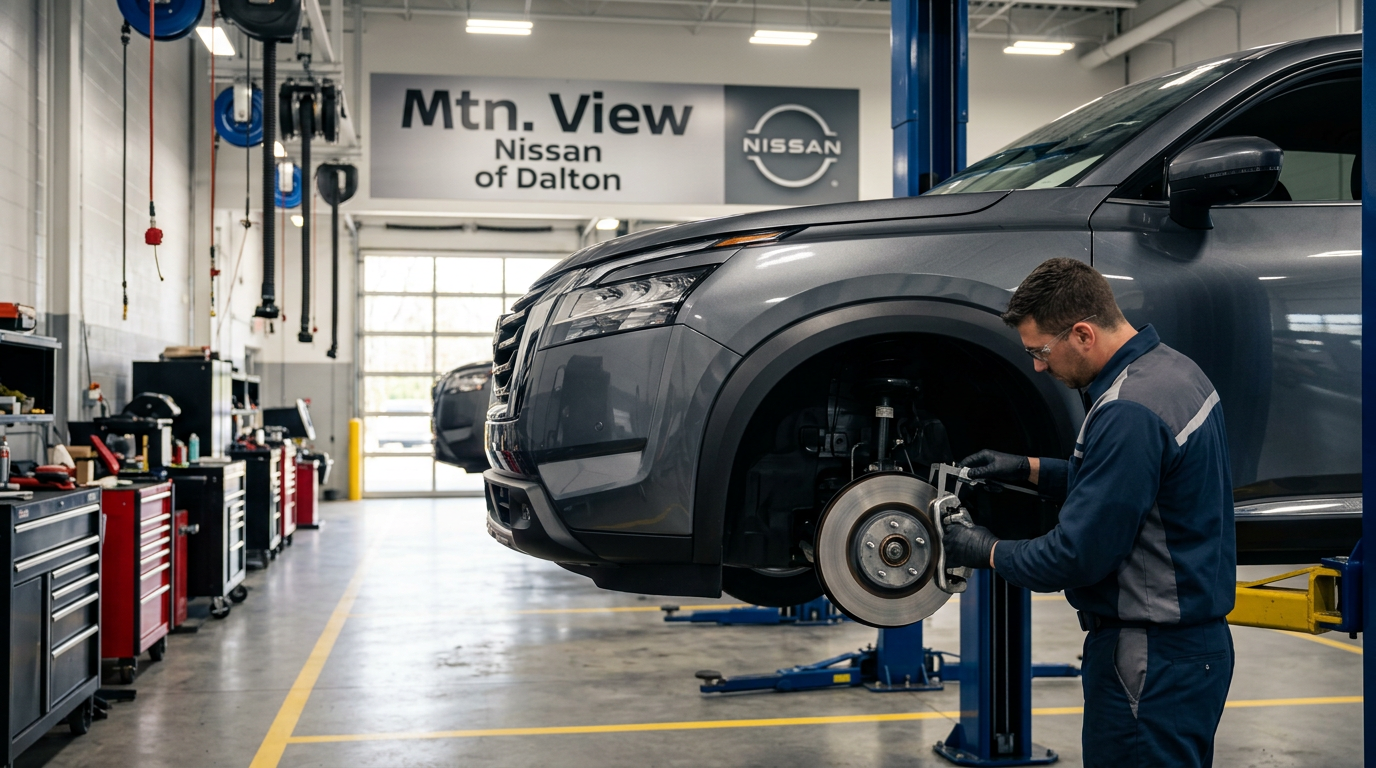
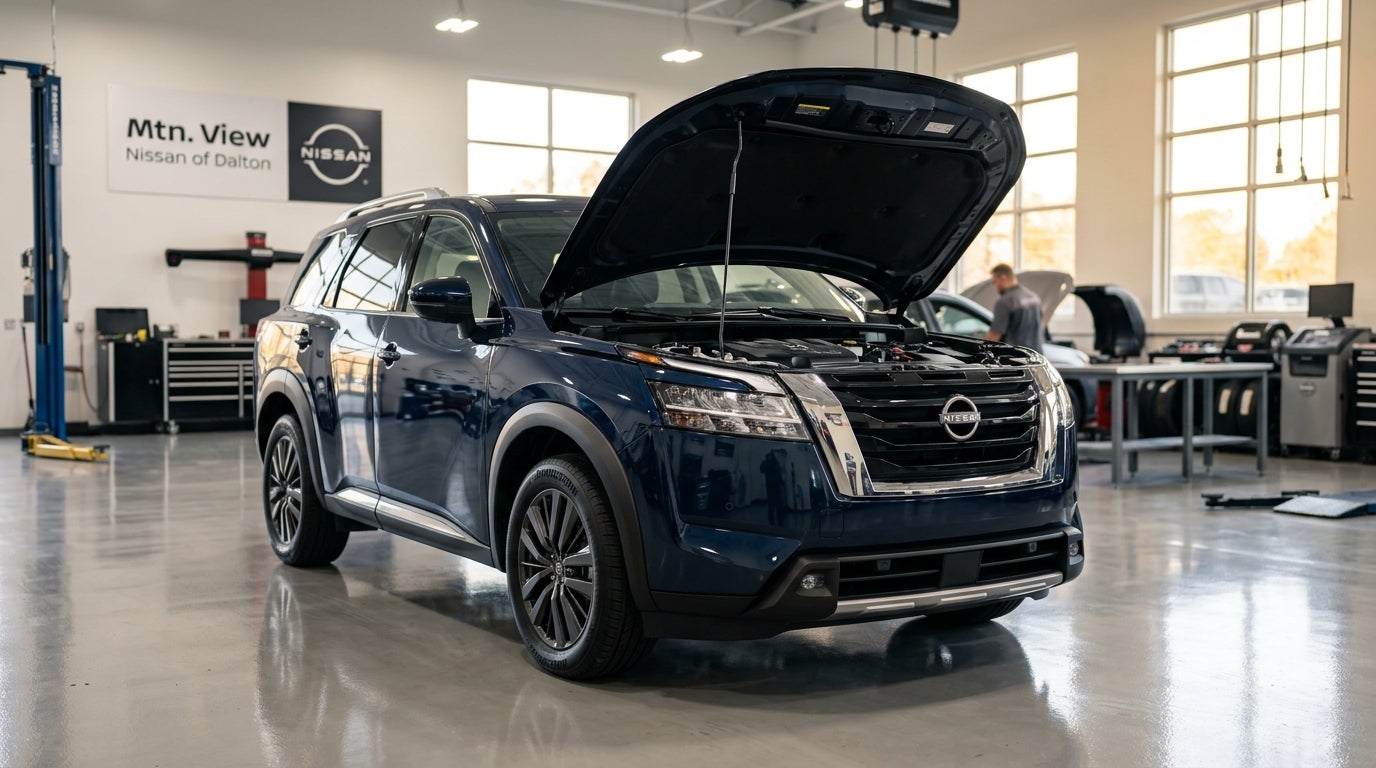
Certified Nissan fluid exchanges and top-offs in Dalton require specialized factory diagnostic tools, exact OEM fluid formulations, and factory-trained technicians found at franchised service departments. Our service department provides dedicated maintenance facilities specifically equipped to service advanced powertrains, cooling systems, and hydraulic brake components according to exact manufacturer specifications.
Industrial manufacturing schedules and commercial freight corridors around Dalton subject 2027 Sentra passenger cars, 2027 Rogue SUVs, and 2027 Frontier pickup trucks to rigorous daily wear. Navigating daily shift traffic along industrial park routes accelerates thermal breakdown in motor oils and transmission fluids. Generic repair shops often utilize universal lubricants that lack the precise friction characteristics, anti-foaming agents, and viscosity curves demanded by Nissan engineering.
Selecting authorized dealership maintenance guarantees several essential operational standards:
- Technicians trained extensively on Nissan platforms, steering gear configurations, and electrical architectures.
- Direct access to factory diagnostic computers capable of reading internal system sensors and resetting transmission deterioration values.
- Exclusive use of genuine fluids, including Nissan Long Life Coolant, Genuine DOT 3, and genuine NS-2 or NS-3 transmission fluids.
- Express service lanes that perform multi-point inspections, battery health evaluations, and basic fluid top-offs without requiring extended downtime.
- Service amenities designed for convenience, including comfortable customer waiting areas, high-speed Wi-Fi, and local shuttle options.
Independent maintenance facilities can perform general fluid changes, but non-franchised facilities rarely possess the dedicated computer software required to verify fluid levels at precise temperatures or reset proprietary transmission wear counters. Entrusting your vehicle to factory-trained technicians ensures that all service work aligns directly with current factory technical bulletins and vehicle warranty requirements.
Nissan Fluid Maintenance FAQs: CVT, Brake Fluid, and Service Intervals
Q: Can universal automatic transmission fluid be used in a Nissan Xtronic CVT?
No, multi-vehicle or universal transmission fluids must never be installed in a Nissan continuously variable transmission. Universal fluids are formulated for conventional geared automatic transmissions that require specific slip rates between clutch packs. Nissan transmissions rely on exclusive traction fluids, such as Nissan NS-2 or Nissan NS-3, formulated to prevent metal-to-metal belt slippage against polished pulley sheaves under extreme hydraulic pressure. Using generic or non-approved fluid can cause sudden belt slippage, rapid internal overheating, pulley scoring, and complete mechanical transmission failure.
Q: Does missing scheduled CVT fluid services void a Nissan factory warranty?
Failing to complete scheduled transmission fluid inspections or replacements can lead to warranty claim denials if a failure stems directly from fluid neglect or thermal degradation. The Nissan factory powertrain warranty protects against defects in factory materials and workmanship, but it does not cover mechanical damage resulting from lack of required maintenance, fluid contamination, or improper fluid types. To safeguard active warranty coverage, always follow the maintenance schedule in your vehicle manual and keep comprehensive digital service records from an authorized service center.
Q: How many quarts of fluid are replaced during a Nissan CVT drain and fill?
A standard drain and fill procedure replaces approximately four to five quarts of transmission fluid, depending on the specific model and transmission pan size. The entire internal system contains between seven and nine quarts, with the remaining volume retained inside the torque converter, internal valve passages, and cooling lines. Because a single service replaces roughly half of the total fluid volume, technicians often recommend recurring drain and fill services at consistent mileage intervals to maintain fresh additive packages and keep fluid contamination low throughout the transmission's operating life.
Q: How do technicians determine if Nissan engine coolant needs replacement?
Technicians evaluate engine coolant condition using chemical test strips and digital refractometers to measure glycol concentration, freeze point protection, and pH acidity levels. While factory blue long-life coolant maintains a baseline service interval of 105,000 miles or seven years, thermal cycling and atmospheric exposure gradually deplete the corrosion inhibitors protecting the aluminum engine block, cylinder head, and radiator core. When coolant becomes acidic, electrochemical degradation accelerates head gasket and heater core wear, signaling the need for a complete system drain, flush, and refill with genuine long-life fluid.
Q: Do modern Nissan vehicles require routine power steering fluid flushes?
Most modern Nissan vehicles do not require routine power steering fluid flushes because they utilize electric power steering systems that eliminate hydraulic pumps, fluid reservoirs, and high-pressure lines entirely. However, select larger Nissan trucks and older passenger car platforms still employ conventional hydraulic power steering systems that require periodic fluid inspection and replenishment with approved lubricants. Reviewing your specific model manual confirms whether your steering system is fully electric or hydraulic; our technicians can inspect the system when you schedule a service appointment online.
Protecting Your Powertrain with Scheduled Fluid Care
Consistent fluid maintenance forms the foundation of powertrain reliability, preserving smooth drivability, fuel efficiency, and structural component longevity across thousands of miles. Delaying fluid exchanges allows heat, moisture, and particulate debris to degrade critical tolerances within your engine, braking system, and transmission assembly. Adhering to factory-specified fluid intervals protects you from costly mechanical repairs down the road.
Our factory-certified service center is fully equipped with factory diagnostic equipment and genuine fluids engineered specifically for your vehicle. For drivers navigating the daily commutes and rolling valley highways of Dalton, our team delivers complete automotive care tailored to your vehicle's specific maintenance schedule.
Protect your vehicle's performance by booking your next maintenance visit with our service team. Contact our service department at (706) 459-3600 or plan your route directly to our dealership at 1706 E Walnut Ave, Dalton, GA 30721 to ensure your vehicle stays running at its best.
© 2026 Mtn View Nissan of Dalton. All rights reserved.