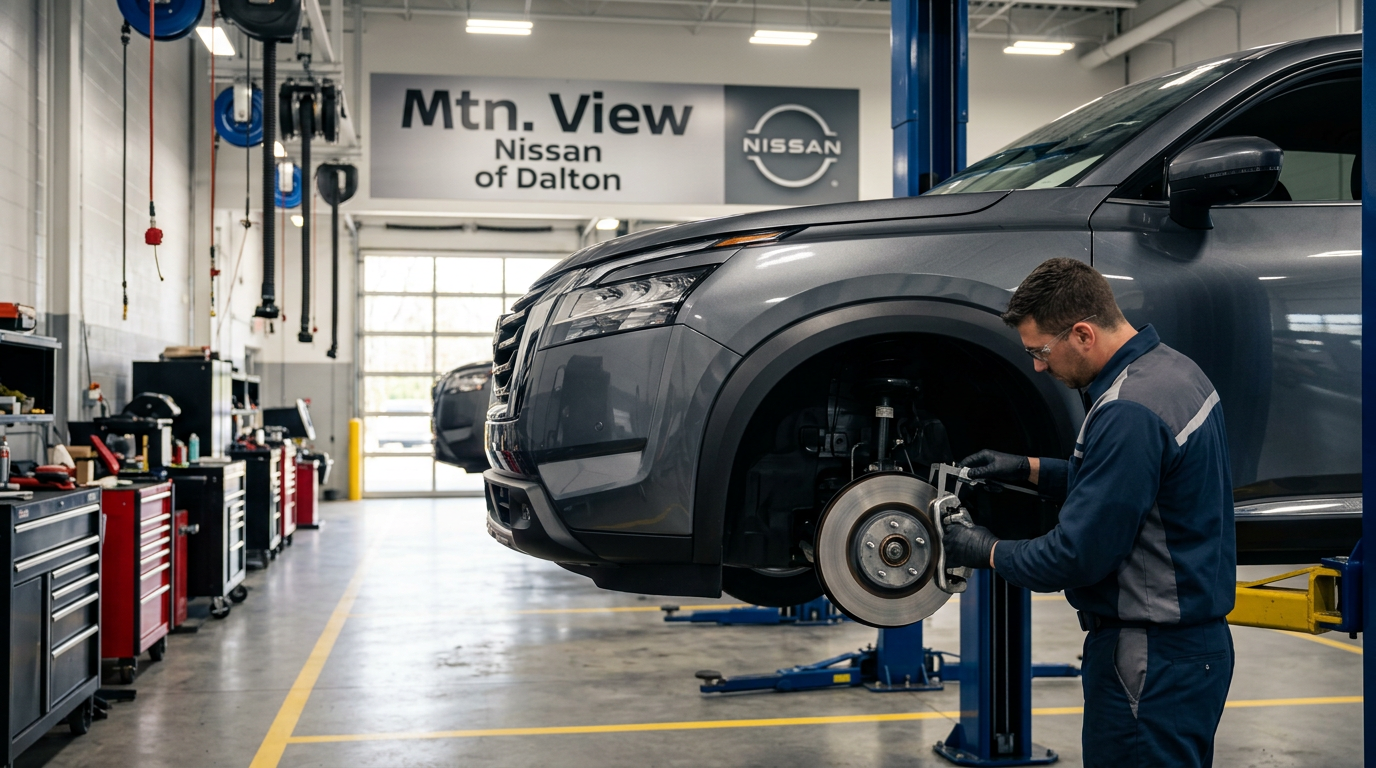

A Nissan Pathfinder requires a comprehensive brake inspection every 5,000 miles or 6 months during routine oil change and tire rotation appointments, while brake pads typically require replacement between 30,000 and 70,000 miles. Brake fluid should be flushed every 20,000 miles or 24 months to maintain hydraulic system pressure and prevent internal corrosion. Drivers carrying full passenger loads or towing up to the maximum 6,000-pound towing capacity should inspect friction components more frequently to ensure optimal stopping capability. Stopping power on a three-row SUV carrying up to eight passengers relies on healthy friction surfaces and uncompromised hydraulic pressure. Daily stop-and-go commuting through local industrial corridors and school drop-off lines places recurring thermal load on the brake pads. During every routine service visit, certified technicians measure pad friction material thickness using precision digital calipers. Front brake pads start with approximately 10 to 12 millimeters of friction material; once wear reaches 3 millimeters, replacement is strongly recommended to prevent metal-to-metal contact with the rotors. Driving habits, payload weight, and local geography directly dictate how long brake friction components last. Operating a 4,400-pound SUV across hilly terrain generates substantial friction heat, which accelerates pad wear if downshifting isn't utilized during long descents. Families who regularly haul cargo or utilize their Pathfinder for trailering experience quicker pad thinning than those completing flat highway commutes. If you notice unusual squealing noises, vibration through the steering wheel, or an extended stopping distance, give our team (706) 459-3600 a quick call or visit our Dalton location for a thorough inspection before thin pad backing plates score your rotors. Table of Contents What Braking System and Rotor Specifications Does the Nissan Pathfinder Use? What Is Nissan ProPILOT Assist Brake Control Capability? How Often Should Nissan Pathfinder Brake Fluid Be Flushed? Are Brake Repairs Covered Under the Nissan Pathfinder Factory Warranty? Is Dealership Service Better Than an Independent Shop for Pathfinder Brakes? Common Questions About Nissan Pathfinder Brake Care Where Can You Get Nissan Pathfinder Brake Service and Repairs Near Dalton, GA? What Braking System and Rotor Specifications Does the Nissan Pathfinder Use? The 2026 Nissan Pathfinder uses a power-assisted four-wheel disc braking system with 13.78-by-1.18-inch front rotors and 12.99-by-0.63-inch rear rotors, controlled by standard four-wheel Anti-lock Braking System, Electronic Brake-force Distribution, and Brake Assist. In instrumented automotive road testing, this braking hardware brings the Pathfinder from 60 to 0 mph in approximately 122 feet, providing controllable stopping performance for a midsize crossover. The heavy-duty ventilated rotor design allows air to circulate between the inner and outer braking surfaces, rapidly dissipating heat accumulated during aggressive braking or mountain descents. The front dual-piston hydraulic calipers squeeze high-friction ceramic or semi-metallic brake pads evenly across the wide rotor face, ensuring linear pedal response. Standard Electronic Brake-force Distribution constantly monitors wheel speed, suspension load, and vehicle pitch, electronically routing braking pressure to the axle with the most traction. Emergency braking scenarios trigger additional mechanical and electronic safeguards built into the system chassis architecture: Brake Assist: Detects panic braking by monitoring the speed at which the brake pedal is depressed, automatically applying maximum hydraulic pressure before the driver's foot hits the floor. Four-Wheel ABS: Prevents wheel lockup on slick surfaces by pulsing brake pressure up to dozens of times per second, maintaining steering control during hard evasive maneuvers. Active Brake Limited Slip: Utilizes brake intervention on individual spinning wheels to transfer engine torque across the axle to wheels with firm traction. Navigating the moderately hilly terrain in the Ridge and Valley region around Dalton requires brake rotors that resist thermal warping. When hot brake pads clamp onto cold or heat-soaked rotors repeatedly, uneven material transfer can create microscopic surface variations. This condition leads to brake pulsation—a rhythmic vibration felt in the brake pedal or steering wheel when slowing down from highway speeds. Keeping rotors within manufacturer thickness tolerances ensures smooth torque absorption without premature pulsation. What Is Nissan ProPILOT Assist Brake Control Capability? Nissan ProPILOT Assist integrates adaptive cruise control with lane-centering assistance, utilizing electronic brake control actuators to modulate vehicle speed, maintain set following distances, and bring the SUV to a complete stop in heavy traffic. Working alongside standard safety features like Automatic Emergency Braking with Pedestrian Detection, Rear Automatic Braking, and Dynamic Brake Support, the system actively manages hydraulic pressure without driver pedal input. When driving in dense traffic, forward-facing radar and optical cameras scan the road ahead for slowing or stopped vehicles. If the vehicle ahead decelerates, the ProPILOT Assist module signals the electronic brake booster to meter precise brake pressure, slowing the vehicle smoothly. In stop-and-go conditions, the system can bring the Pathfinder to a full stop and hold it in place using the electronic parking brake system until traffic moves again. Advanced safety integration extends beyond highway cruising through the standard Safety Shield 360 technology suite: Automatic Emergency Braking with Pedestrian Detection: Monitors forward paths for vehicles and pedestrians, applying partial or full autonomous braking if a collision is imminent. Rear Automatic Braking: Detects stationary obstacles behind the SUV while reversing, automatically applying hard braking to avoid low-speed parking lot impacts. Dynamic Brake Support: Augments driver pedal pressure during sudden collision-avoidance maneuvers to minimize emergency stopping distances. Because driver-assist technologies rely heavily on clean electrical signals, proper brake mechanical maintenance is essential. Worn pads, air in the brake lines, or warped rotors can degrade the smooth execution of automated stopping commands, causing harsh deceleration or system fault codes. Standard electronic stability systems, recognized in national crash-test evaluations like the IIHS TOP SAFETY PICK+ rating and NHTSA 5-Star Overall Safety Rating, depend on calibrated hydraulic responses to keep three-row family vehicles stable. How Often Should Nissan Pathfinder Brake Fluid Be Flushed? Nissan Pathfinder brake fluid should be flushed every 20,000 miles or 24 months under normal driving conditions to eliminate moisture accumulation and maintain high boiling points within the sealed hydraulic lines. Under severe operating conditions—such as frequent towing, mountain driving, or persistent stop-and-go traffic—replacing brake fluid as early as 10,000 miles or 12 months preserves hydraulic responsiveness and protects expensive system valves. Automotive brake fluid is glycol-based and inherently hygroscopic, meaning it continuously absorbs moisture from ambient air through flexible rubber hoses and reservoir seals over time. Even a tiny percentage of water contamination in DOT 3 brake fluid drastically lowers its boiling point. During hard braking, heat generated at the calipers transfers into the fluid; if contaminated fluid reaches its lowered boiling point, the water content vaporizes into steam pockets. Because vapor compresses while liquid does not, the driver experiences a soft, spongy brake pedal that sinks near the floorboard. Moisture in the hydraulic lines also triggers internal corrosion across polished metal components, including the master cylinder piston, anti-lock brake pump valves, and caliper slides. Over time, rust particles and microscopic rubber debris contaminate the fluid, turning it from a clear amber color to dark brown or black. A complete fluid flush vacuums out degraded fluid from every caliper bleeder screw, replacing it with fresh fluid to keep internal seals soft and valve passages clear. Are Brake Repairs Covered Under the Nissan Pathfinder Factory Warranty? Brake pads, shoe linings, and brake rotors are classified as normal wear-and-tear friction items and are excluded from coverage under the 3-year/36,000-mile limited warranty and 5-year/60,000-mile powertrain warranty, unless failure stems directly from a defect in materials or factory workmanship. Non-friction mechanical components—such as the master cylinder, brake booster, ABS hydraulic control unit, and brake lines—are covered against defect-related failures during the basic warranty period. If a caliper piston sticks due to a manufacturing flaw or a master cylinder seal leaks prematurely within 3 years or 36,000 miles, repairs are completed at zero cost to the owner using original equipment components. However, routine pad thinning resulting from mileage, city stop-and-go driving, or towing is the owner's responsibility. When replacing worn friction components, maintaining factory specifications ensures proper performance with integrated driver-assist systems. OEM brake pads feature exact-fit backing plates, factory shim packs, and friction formulations engineered specifically for the Pathfinder's vehicle curb weight and rotor metallurgy. Sourcing components through our parts department guarantees factory-certified fitment, reducing brake dust and eliminating squeaking associated with generic aftermarket alternatives. Is Dealership Service Better Than an Independent Shop for Pathfinder Brakes? While independent repair shops may offer slightly lower labor rates, dealership service provides factory-trained technicians, specialized diagnostic equipment, and genuine factory parts engineered specifically for your three-row SUV. Independent facilities often install one-size-fits-all aftermarket brake pads that can cause unwanted noise, high dust accumulation, or accelerated rotor wear on heavy vehicles. Modern Nissan braking systems involve far more than simple mechanical pad replacement. Features like electronic parking brakes, active brake limited slip, and emergency braking systems require electronic calibration during routine maintenance. Dealership technicians utilize proprietary diagnostic tools to retract electronic parking brake actuators safely into service mode, preventing costly damage to internal caliper motors during pad installation. Comparing service approaches highlights key differences between independent facilities and authorized service centers: Diagnostic Technology: Dealerships connect directly to factory network tools to scan for ABS module software updates, recalibrate sensor offsets, and clear stored fault codes. Component Quality: Dealerships install original equipment pads with custom chamfers and multi-layer shims designed specifically to eliminate cold-weather brake squeal. Warranty Preservation: Official service records at an authorized dealer provide seamless documentation if warranty questions arise regarding related powertrain or safety systems. Technicians who work on Nissan vehicles every day understand exact factory service procedures, torque values, and slide pin lubrication requirements. Correctly lubricating caliper carrier slides with high-temperature silicone grease prevents pad binding, ensuring even wear across both inner and outer friction pads over thousands of miles. Common Questions About Nissan Pathfinder Brake Care Q: What are the primary warning signs that a Nissan Pathfinder needs new brake pads? Key indicators include a high-pitched metallic squealing noise when stopping, a grinding sound during hard pedal pressure, a spongy or soft brake pedal, steering wheel pulsation under deceleration, and increased stopping distances. The high-pitched squeal is created by a built-in mechanical wear indicator contacting the rotor, alerting you that friction material has thinned to critical levels before rotor damage occurs. Q: Does heavy towing with a Pathfinder accelerate brake wear? Towing trailers up to the maximum 6,000-pound towing capacity adds significant kinetic energy that the braking system must convert into thermal energy. This increased heat accelerates pad wear and brake fluid degradation. Pathfinder owners who tow regularly or haul heavy passenger loads should inspect brake pads every 5,000 miles and consider flushing brake fluid annually to prevent fluid boiling on steep highway grades. Q: Why does the brake pedal feel soft or spongy on a three-row SUV? A soft pedal feel usually indicates air bubbles trapped in the hydraulic brake lines, water contamination in the brake fluid, or worn flexible rubber brake hoses expanding under hydraulic pressure. Air and steam compress when the pedal is pressed, absorbing pedal force instead of transferring it to the caliper pistons. A complete brake fluid flush bleeds air and moisture from the lines, restoring firm pedal resistance. Q: Should brake rotors be resurfaced or completely replaced during a brake job? Rotors should be replaced if their thickness measures below the minimum discard specification stamped on the rotor casting, or if deep scoring, heat cracks, or heavy rust lip formation is present. While smooth rotors with adequate thickness can sometimes be resurfaced on a precision brake lathe, replacing rotors along with new pads ensures optimal bedding, maximum heat absorption, and quieter operation. Q: How do ceramic and semi-metallic brake pads compare on a Pathfinder? Ceramic brake pads produce minimal dark dust and operate silently during daily city driving, making them ideal for commuting and family errands. Semi-metallic brake pads offer higher thermal conductivity and stronger cold-bite friction, making them suitable for heavy towing or severe driving conditions, though they generate slightly more visible dust on aluminum wheels. Where Can You Get Nissan Pathfinder Brake Service and Repairs Near Dalton, GA? For expert Nissan Pathfinder brake inspections, rotor resurfacing, fluid flushes, and pad replacements near Dalton, trust the factory-certified service center at Mtn View Nissan of Dalton. Our team uses specialized factory diagnostic tools and genuine Nissan parts to ensure your three-row SUV maintains its stopping performance and advanced driver-assist functionality across every commute. Local drivers operating daily along the manufacturing corridors and rolling hills around Dalton demand reliable stopping power in all traffic conditions. Whether you need a quick 5,000-mile brake pad wear check during a routine oil change or a full four-wheel rotor and caliper service, our certified technicians complete every job according to strict factory specifications. We verify rotor thickness, inspect hydraulic lines, top off fluid reservoirs, and reset electronic brake systems to keep your family safe on the road. Taking care of your Pathfinder's braking system is straightforward with flexible service options: Schedule Ahead: Easily reserve your appointment online to pick a time slot that matches your busy family schedule. Speak with Advisors: Call our knowledgeable service desk to discuss current maintenance needs, wear symptoms, or service specials. Visit Our Location: Conveniently located on East Walnut Avenue, our facility offers a comfortable waiting area while your vehicle is serviced. Ready to restore factory pedal feel and braking confidence to your SUV? You can schedule a service appointment online today, give our service team (706) 459-3600 a call, or drive straight to our service bay at 1706 E Walnut Ave, Dalton, GA 30721 for a professional multi-point brake inspection. © 2026 Mtn View Nissan of Dalton. All rights reserved.